Reconstructive Surgery

Reconstructive surgery is performed on abnormal structures of the body caused by congenital defects, developmental abnormalities, trauma, infection, tumours or disease. It is generally performed to improve functions, but may also be done to approximate a normal appearance. Reconstructive surgery is generally covered by most health insurance policies, although coverage for specific procedures and levels of coverage may vary greatly
Plastic Surgery - Focuses on Repairing Defects to Reconstruct a Normal Function & Appearance
Plastic surgery is the branch of surgery specialising in repairing and reconstructing missing or damaged tissue and skin, usually because of surgery, illness, injury or an abnormality present from birth
The main aim of plastic surgery is to restore the function of tissues and skin to as close to normal as possible. Improving the appearance of body parts is an important, but secondary aim
Plastic surgery is different to cosmetic surgery, which is surgery carried out solely to change a healthy person’s appearance to achieve what they feel is a more desirable look
Plastic surgery is defined as a surgical specialty dedicated to reconstruction of facial and body defects due to birth disorders, trauma, burns, and disease. Plastic surgery is intended to correct dysfunctional areas of the body and is reconstructive in nature. While many plastic surgeons choose to complete additional training and perform cosmetic surgery as well, the basis of their surgical training remains reconstructive plastic surgery
Examples of plastic surgery procedures:
• Breast Reconstruction
• Burn Repair Surgery
• Congenital Defect Repair: Cleft Palate, Extremity Defect Repair
• Lower Extremity Reconstruction
• Scar Revision Surgery
Microvascular Surgery
Microvascular surgery or microsurgery is a surgical technique for joining or repairing the damaged blood vessels and nerves during reconstructive surgery of body parts. Reconstructive surgery is the transfer of muscles and large segments of skin, fat, and bone from one part of the body to another
Free Flap
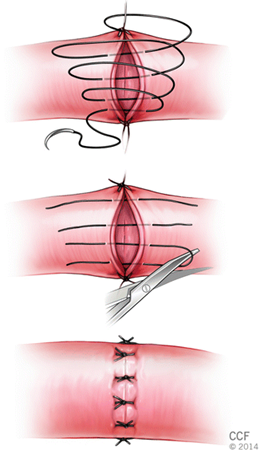
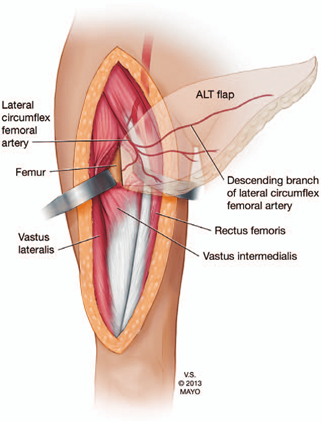
The terms free flap or free autologous tissue transfer and microvascular free tissue transfer are synonymous terms used to describe the transfer of a patient's own tissue from a donor site to a recipient site, which is typically the site of a defect. The donor site usually has a distant location with respect to the recipient site
DIEP Flap
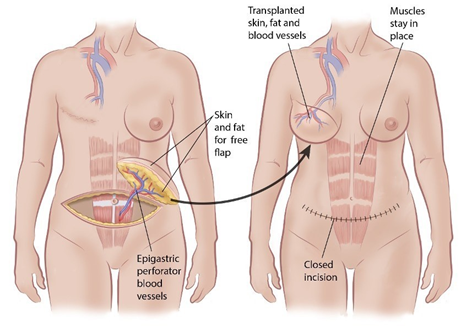
A DIEP flap is type of breast reconstruction in which blood vessels called deep inferior epigastric perforators (DIEP), fat and skin from the lower abdomen are relocated to the chest to rebuild breasts after mastectomy. The abdominal muscle is left in place
TRAM Flap
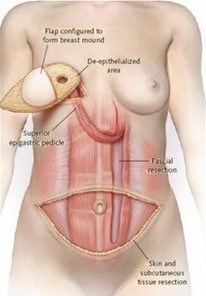
During a pedicle TRAM or traverse rectus abdominal muscle flap procedure, surgeons use fat, skin, blood vessels, and muscle from your lower abdominal wall to reconstruct the breast
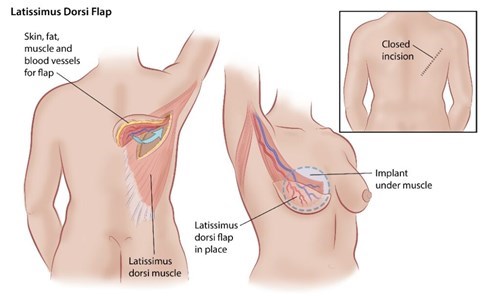
Latissimus Dorsi Flap
The latissimus dorsi flap is a highly versatile reconstructive option used in various reconstruction surgeries. In this flap procedure the surgeon harvests the flap from the latissimus dorsi muscle, which is richly vascularized by the thoracodorsal vessels
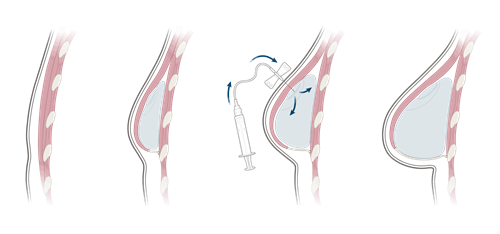
Tissue-expander
A tissue expander is an empty adjustable breast implant. It may be placed during a mastectomy or in a second surgery after you’ve healed and finished cancer treatment
Tissue expanders are used for recruiting skin envelope to create sufficient space for prosthesis placement in breast reconstruction